
 Become A Jaguar
  Request Info
  Apply
Apply  Get Game Tickets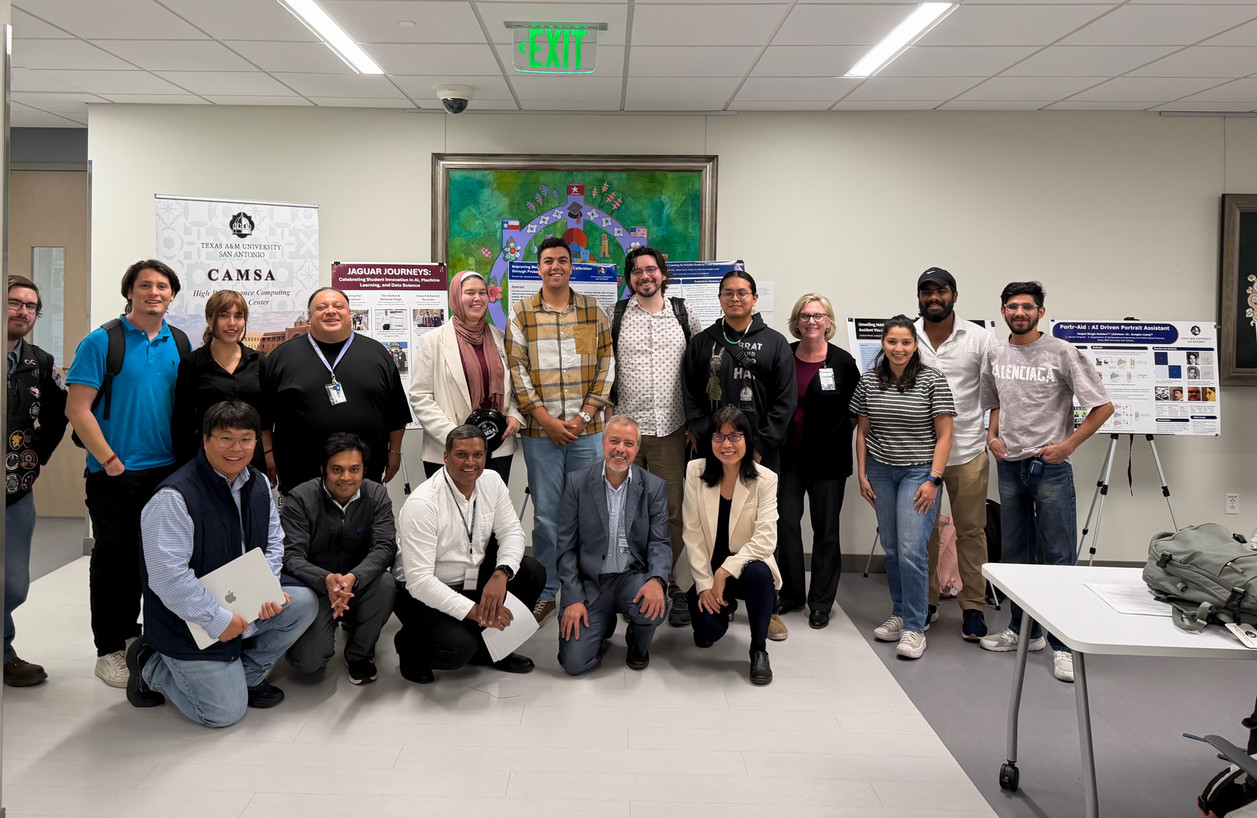
NSF ECR WORKSHOP 2026
Team HPRC thanks all students, researchers, faculty, staff and management/IT personnel who made our workshop successful on April 7, 2026!
NEXT WORKSHOP DATE: (FALL 2026) SEPTEMBER 17, 2026
Organizing Committee (TAMUSA):
- Dr. Izzat Alsmadi
- Mr. Joe Rasche
- Dr. Gongbo Liang
- Dr. Yuvaraj Munian
- Dr. Srinivasan Murali
Sessions Gallery
Workshop Trainers:
- Dr. Wesley Brashear- Texas A&M University
- Dr. Zhenhua He- Texas A&M University
- Dr. Yuvaraj Munian- Texas A&M University- San Antonio
- Dr. Srinivasan Murali- Texas A&M University-San Antonio
ECR Training Workshop (Spring 2026) Topics:
- Morning Session: 9.30AM- 12PM (HPC):
- Topic: Introduction to High Performance Computing:
- Accessing the TAMU HPRC Launch Computing Resource, Introduction to the JupyterLab interface, Python on HPC.
- Topic: Introduction to High Performance Computing:
- Afternoon Session A: 1PM-4PM (Health Sciences) :
- Topic: Applications of AI/ML in the Biological and Biomedical Sciences:
- Protein Structure Prediction with AlphaFold 3, Genomic Variant Calling with Google's DeepVariant, Single-cell Omics Data Analysis with scci-tools, Data Mining with BioBERT.
- Topic: Applications of AI/ML in the Biological and Biomedical Sciences:
- Afternoon Session B: 1PM-4PM (Computer Science) :
- NLP and Large Language Models: A Hands-on Introduction with Transformers:
- Tokenization, Converting text to numerical IDs, Generating embeddings with BERT, Sentiment analysis, Question answering.
- NLP and Large Language Models: A Hands-on Introduction with Transformers:
Project Overview:
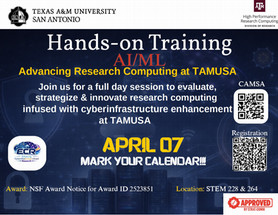
Enhancing Cyberinfrastructure-infused Research at Texas A&M University-San Antonio (ECR-TAMUSA) seeks to empower Texas A&M University San Antonio by building long-term capacity in high-performance computing (HPC) and artificial intelligence and machine learning (AI/ML) for its research and academic programs. The university will develop a support structure to meet the growing needs of advanced cyberinfrastructure (CI)-infused research in water-management, genomics, biology, chemistry, health, computing, humanities, social, natural, cybersecurity, and other applied sciences. This project addresses that gap through a sustainable and collaborative model that enhances multidisciplinary faculty collaborations on computational research, development of academic programs, and student research participation. This initiative is led by PI Dr. Izzat Alsmadi.
This is supported by NSF Grant #2523851.